
Based on a real dispatch call: Nude man on motorcycle reported harassing workers, Moultrie, GA, 5:57 AM EST, Wednesday, Nov 4, 2026.
Hollis Tubb had never thought of himself as a criminal. He thought of himself as a man who had walked out of the Piggly Wiggly on First Avenue with a jug of Mountain Fresh laundry detergent tucked under his arm, and then kept walking, and then got on his motorcycle and kept going. That’s a different thing. That’s absentmindedness with good acceleration.
It was $11.49. He’d meant to pay. He’d had the money right there in his pocket, in quarters, because Hollis paid for everything in quarters. He said it kept the economy honest. But the line was long, the self-checkout was yelling at a lady about an unexpected item in the bagging area, and Hollis had a load of whites going cold at home. So he left.
The Colquitt County Sheriff’s Office took a dimmer view of this than Hollis did. A warrant was issued. Hollis didn’t know about it. Hollis didn’t know about a lot of things. He’d once gone eleven months without knowing his phone had a camera.
What Hollis did know was that he was a good man, and good men don’t wear stolen clothes.
This came to him at 4:40 a.m. on Wednesday, Nov 4, while he was lying awake listening to the dryer. He had used the Mountain Fresh. He had used it on everything. Every shirt, every pair of jeans, every sock, his church slacks, his Braves jersey, and the camouflage overalls he wore to funerals. Every stitch Hollis Tubb owned had been laundered in stolen goods.
He sat up in bed.
“That’s fruit of the poisoned tree,” he said to nobody. He had heard it on a TV show once and had been waiting about nine years to use it.
He could not, in good conscience, put on a single thing in that dryer until he had paid the Piggly Wiggly back. And he could not wait. His conscience had never been loud before, and now it was making up for lost time.
He got the coffee can of quarters from the top of the refrigerator and counted out fifty quarters, $12.50, enough to cover the $11.49 plus a dollar for interest, because he was not raised in a barn. Then he looked around the house for anything that hadn’t touched the detergent.
There was one item. The brown paper Piggly Wiggly grocery sack he’d carried the jug out in. It was clean. It was innocent. It was, he figured, roughly his size if he cut two holes in the bottom and didn’t sit down too fast.
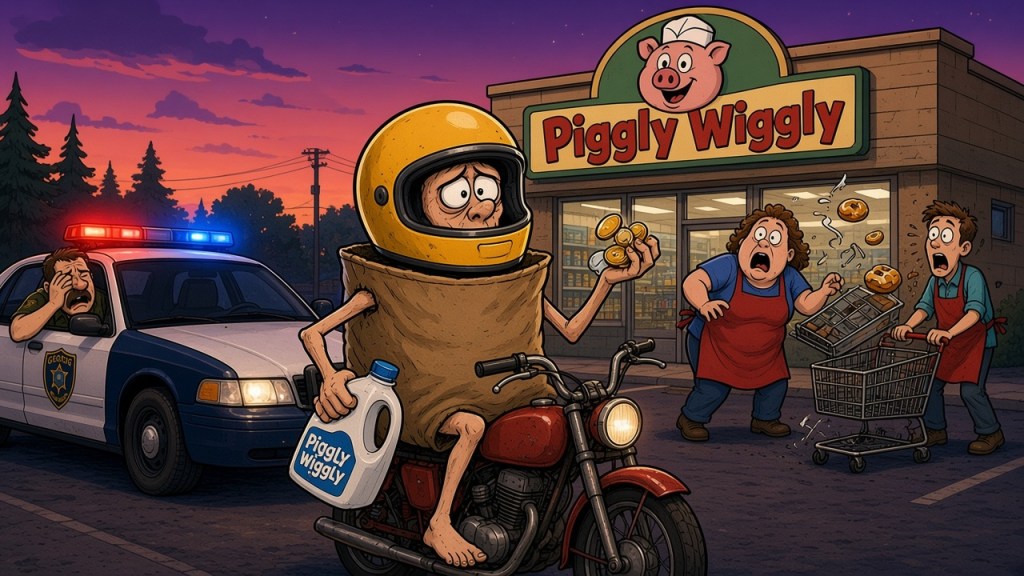
He put on the sack. He put on his helmet, a big mustard-yellow full-face model he’d bought at a yard sale in Norman Park. It made his head look like a lemon on a stick. He got on his motorcycle, a 1981 Honda named Delphine that started on the third kick out of spite, and he rode toward town with a chilly November breeze whistling through the leg holes.
The Piggly Wiggly doesn’t open until seven. Hollis didn’t know that either.
At 5:50 a.m., the early crew was coming in through the side door. Miss Verlie Haskew had run the bakery for twenty-six years. She was carrying the first tray of honey buns from her car, because she did the glaze at home, where nobody could watch. Behind her came Tyrese Gaskins, seventeen, the stock boy, who was pulling in carts from the lot and listening to a podcast about ancient Rome.
Delphine came puttering across the parking lot like a lawnmower with ambitions.
She stopped right in front of the side door. The rider sat up straight in his grocery sack, flipped up his visor, and held out both hands. One held a fistful of quarters. The other held an empty jug of Mountain Fresh.
“Ma’am,” Hollis said. “I need to make this right.”
Miss Verlie looked at the sack. She looked at the helmet. She looked at the knobby bare knees poking out the bottom like two doorknobs. She didn’t drop the honey buns, which everyone later agreed was the most heroic thing that happened in Moultrie that week. She did let out a sound like a teakettle discovering religion.
Tyrese let go of the carts. Fourteen of them rolled gracefully across the lot and came to rest against a light pole.
“Sir,” said Tyrese, “are you okay?”
“I’m wearing the only honest thing I own,” said Hollis.
“Sir, you’re wearing a bag.”
“It’s a Piggly Wiggly bag,” said Hollis, like that settled it.
He tried to give Miss Verlie the quarters. She backed up. He followed her, slowly, on Delphine, at about one mile an hour, still holding out the money like he was trying to feed a skittish horse. She backed up some more. He followed some more. From a distance it looked like a very low-speed chase. From up close it looked worse.
Tyrese called 911. He had never called 911 before and wanted to get the details right.
“There’s a man on a motorcycle,” he said, “with no clothes on. He’s harassing people. We’re coming in to work.”
“No clothes at all?” said the dispatcher, a patient woman named Ronda Spivey.
Tyrese looked over again. Hollis was now trying to hand a quarter to the pig on the sign.
“He’s got a bag,” Tyrese said. “But I don’t think it counts.”
Deputy Lamar Hightower got the call at 5:57 a.m., two bites into a pecan waffle at the Huddle House on Veterans Parkway. He was thirty-eight years old and had spent fourteen of them in uniform. He had seen a man ride a lawnmower through a Sonic drive-thru, and he had once had to arrest a goat. He put down the waffle, which told you everything.
He pulled into the Piggly Wiggly lot at 6:11 with his lights going. He took one look at Delphine, the sack, and the lemon-colored helmet, and put his hand over his eyes. It was not for decency. It was for strength.
“Morning, Hollis,” he said through his fingers.
“Morning, Lamar.”
“You want to tell me what’s going on?”
Hollis explained everything: the detergent, the dryer, fruit of the poisoned tree, the coffee can, and the interest. Deputy Hightower listened all the way through without interrupting. Then he got on the radio, and Ronda had news. Hollis Tubb had an outstanding warrant for shoplifting from that exact Piggly Wiggly.
“Well,” Lamar said to Hollis. “Good news is you’re at the scene of the crime. Saves gas.”
He requested a hold. Then he went to his trunk and came back with a pair of gray Colquitt County Sheriff’s Office sweatpants, which he kept for exactly this kind of morning, though he had always assumed it would be a different kind of morning.
“These clean?” said Hollis.
“County detergent,” said Lamar. “Paid for.”
Hollis put them on behind the patrol car, under the sack, with Tyrese holding a flattened cardboard box up as a privacy screen and keeping his eyes on the Roman Empire.
The store manager, Mr. Burl Nesmith, came in at 6:30 and found a deputy, a motorcycle, fourteen loose carts, and his bakery manager sitting on the curb eating one of her own honey buns, which she never did.
Hollis handed him $12.50 in quarters. Mr. Nesmith counted them, because he was a grocer, and then he gave Hollis a receipt and one cent in change, because he was a professional.
“You know you could’ve just come in at seven,” Mr. Nesmith said. “With pants.”
Hollis looked down at his receipt for a long time. “I don’t think I could have, Burl,” he said. “I don’t think I could have lived with myself till seven.”
Miss Verlie stood up, brushed the glaze off her hands, and gave Hollis a honey bun for the road. Lamar let him eat it in the back of the cruiser.
The hold got sorted out by lunch. Hollis came home to a dryer full of clothes he could finally wear with a clear conscience. He folded them slowly, like a man who had been through something.
The paper sack hangs in the Piggly Wiggly break room now, in a frame Tyrese bought at the Dollar General. Under it is a little card in Miss Verlie’s handwriting:
PAY AT THE REGISTER. IT’S EASIER.
Hollis still shops there every Saturday. He pays in quarters. He always buys Mountain Fresh.
He says it smells like a fresh start.
Stories are inspired by actual dispatch calls reported on CrimeRadar. Aside from the linked emergency services dispatch, the people and events described are fictitious.
Stories and illustrations were developed with the help of Grok, an AI assistant, and edited by the author.


Leave a Reply