
Based on a real dispatch call: Man with miniature horse refuses to leave lobby, 190 S. LaSalle St., Chicago, IL, 1:13 PM EDT (12:13 PM CDT), Monday, Oct 26, 2026.
Leonard Szymanski had worked on the thirty-first floor of 190 South LaSalle for nineteen years, and in all that time he had never once been allowed to bring anything into the building that mattered to him. They wouldn’t let him bring a bike. They had taken away his space heater during the Great Breaker Incident of 2019. When he brought in a sourdough starter named Carl, Facilities had labeled it a “biohazard of unknown origin” and thrown it out while he was at a dentist appointment.
So when his therapist, a soft-spoken woman in Andersonville who charged two hundred dollars an hour to tell him he “carried a lot,” suggested an emotional support animal, Leonard took it as a challenge.
Most people get a dog. Leonard got Biscotti.
Biscotti was a chestnut miniature horse about the height of a kitchen counter. Leonard bought her from a woman in Kankakee who had raised her for a petting zoo that went under. She was calm. She was soft. She looked at you with big, wet, nonjudgmental eyes, the way nobody in Accounts Receivable ever had. She also cost $340 a month to board in a converted garage in Bridgeport, and that was the real reason Leonard decided she was coming to work. He couldn’t afford two lives. One of them had to commute.
Getting a miniature horse into the Loop on a Monday was harder than Leonard expected.
The Orange Line was out, because the conductor took one look at Biscotti on the Halsted platform and said, “Absolutely not, my guy.” The bus was out because she wouldn’t climb the steps, even with a carrot. A cab driver on Archer agreed to take them for a flat forty dollars, then spent the whole ride on Lake Shore Drive livestreaming in Polish to what sounded like his entire extended family. Biscotti rode in the back seat with her head out the window. Leonard sat up front, holding a laminated letter from the therapist and feeling, for the first time in years, like a man with a plan.
They got out on LaSalle at 12:04 p.m., right as the lunch rush poured out of every revolving door in the canyon. Traders headed for the Board of Trade. Lawyers gripped forty-dollar salads. A bike messenger nearly went over his handlebars when he saw them. A man selling StreetWise stopped in mid-pitch, looked Biscotti over, and said, “Respect.” Biscotti left a small, perfectly round contribution on the sidewalk in front of a Sweetgreen. Leonard picked it up with a Walgreens bag, because he was not an animal.
Then they went through the revolving door. Biscotti took two full rotations to find the exit, and they were inside.
The lobby of 190 South LaSalle is forty feet of marble and gold leaf, the kind of lobby built to remind you that somebody upstairs makes more money than you. Its gatekeeper was Reginald Okonkwo-Bates, Head of Lobby Security, a man built like a vending machine. He took his job about as seriously as the Secret Service takes theirs.
Reginald watched them cross the lobby. Before they reached the turnstiles, he had his radio out.
“Sir.”
“Afternoon, Reggie.”
“Sir, that’s a horse.”
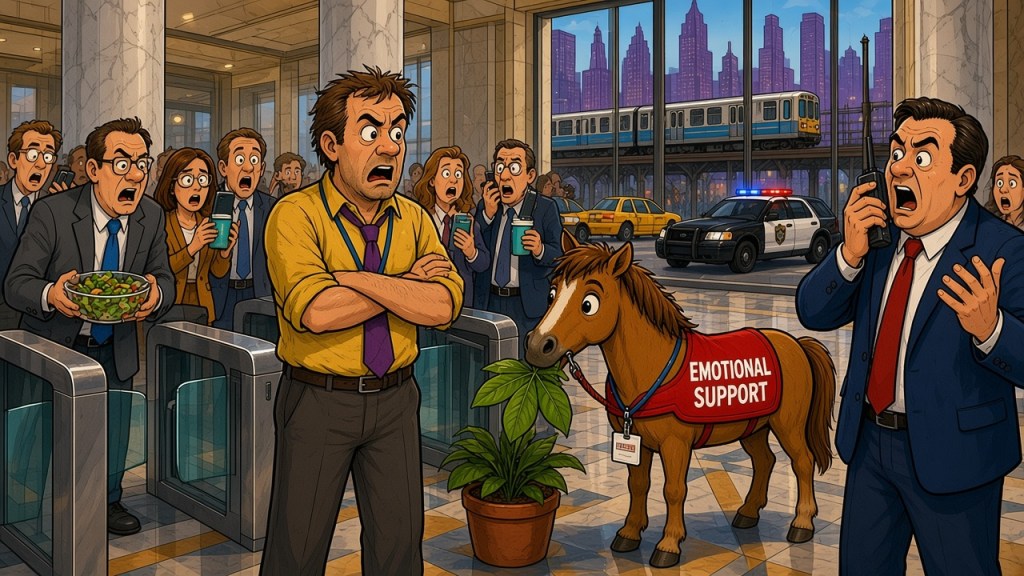
“She’s a miniature horse,” Leonard said, the way you’d correct someone who called a Tesla a car. “She’s my emotional support animal. I have a letter.”
He held up the laminated letter. Reginald didn’t take it. Reginald had seen a lot of letters. In the last year alone, he had turned away an emotional support iguana, an emotional support ferret in a baby carrier, and a woman who said her emotional support animal was “the concept of her late husband” and needed the elevator held for it.
“Building policy,” Reginald said, “is service dogs only. Horse has to go outside.”
“She’s never been outside alone in the Loop. Look at her. She’d be eaten alive.”
Everyone looked at Biscotti. She was eating the lobby ficus.
“Sir,” said Reginald, “she’s eating the ficus.”
“She’s stressed,” said Leonard. “This is a high-stress environment. Do you know how many people in this building have cried in the stairwell? I do. I’ve been most of them.”
By 12:09, the lobby had an audience. Two paralegals from Kirkland & Ellis were filming. A guy in a Patagonia vest had stopped to explain to nobody in particular that miniature horses are covered under the ADA, which was half true, and he said it with the kind of confidence that’s never really true. A woman from the coffee kiosk came out with a cup of water and set it down for Biscotti, which Leonard took as a sign that the public was on his side.
“I’m not leaving,” Leonard said. “We’re going up to thirty-one. I have a twelve-thirty with Treasury. Biscotti’s been prepping.”
“The horse is not going to thirty-one.”
“The horse has a name.”
“Biscotti is not going to thirty-one.”
Leonard drew himself up to his full five foot eight. He was wearing his good mustard-yellow shirt and the purple tie his sister said made him look “like a sad sports mascot.” He had come too far. He had paid the Polish cab driver. He had carried poop down LaSalle Street in a Walgreens bag.
“Reggie,” he said, very quietly, “if you touch this horse, I will end you.”
This was not, strictly speaking, a sentence Leonard had ever said before. It came out of him like a hiccup. He was as surprised as anyone. Biscotti looked up from the ficus with what appeared to be pride.
Reginald, who had once taken down a man trying to steal the lobby’s Christmas tree by himself, did not flinch. He keyed his radio.
“Dispatch, this is 190 South LaSalle. I’ve got a male in the lobby refusing to leave. He’s got a horse.”
A pause.
“Repeat that?”
“A horse. A small one. He’s threatening security.”
Somewhere in the 1st District, a dispatcher who had heard everything Chicago could offer, including a man on Lower Wacker who called 911 to report that a pigeon had “disrespected” him, typed it in with a straight face. Since a threat had been made, it went out as an assault in progress. The radio didn’t sound urgent about it. It sounded tired, like a Monday.
Two officers arrived at 12:21. They parked their SUV on LaSalle in the bus lane, and the No. 134 driver leaned on his horn for a full fifteen seconds. Officer Danny Kowal walked in first. He looked at Leonard, then at Biscotti, then at the ficus, which was now about forty percent stem. He took off his hat and rubbed his forehead like a man doing math.
“Okay,” he said. “Who’s the horse?”
“Biscotti,” said Leonard and Reginald at the same time, and then glared at each other for agreeing.
It took twenty minutes. It took Officer Kowal’s partner, a no-nonsense woman named Officer Teresa Flores, crouching down to Biscotti’s level and saying, “Hey, mama, you wanna go see the river?” It took Leonard being reminded, gently, that threatening to end a building’s head of security is still a thing you can’t say, even when your horse has a letter. It took the coffee kiosk lady giving Biscotti a banana as a peace offering.
In the end, Leonard walked out the revolving door the way he came in, holding a lead rope. Biscotti took two rotations again. Nobody was charged. Officer Kowal wrote “subject agreed to relocate equine” on his report, then stared at the sentence for a long moment as if he were reconsidering his whole career.
Leonard never made his twelve-thirty with Treasury. Treasury, it turned out, had watched the whole thing on the paralegals’ Instagram story and voted unanimously to reschedule.
The next morning, Reginald Okonkwo-Bates arrived for his shift and found something taped to the security desk. It was a visitor badge from the 31st floor, made out by hand in Leonard’s careful accountant’s printing:
NAME: BISCOTTI
COMPANY: EMOTIONAL SUPPORT
HOST: L. SZYMANSKI
ACCESS: LOBBY ONLY
Reginald looked at it for a long time. Then he pinned it to the corkboard behind the desk, right between the photo of the Christmas tree thief and the sign that read NO IGUANAS.
The ficus was replaced the following week. Facilities chose a plastic one.
Nobody asked why.
Stories are inspired by actual dispatch calls reported on CrimeRadar. Aside from the linked emergency services dispatch, the people and events described are fictitious.
Stories and illustrations were developed with the help of Grok, an AI assistant, and edited by the author.


Leave a Reply